
What is answer engine optimization?
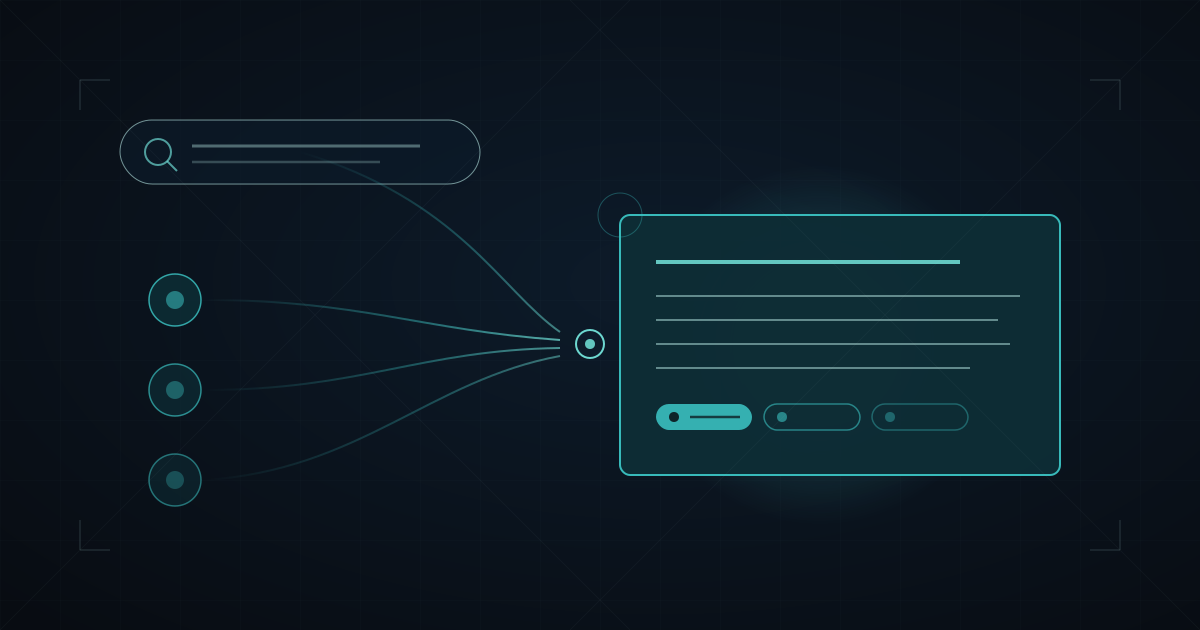
Answer engine optimization (AEO) is the practice of structuring and sourcing your content so answer engines cite it inside the response they generate, rather than only listing it as a blue link. Answer engines include Google AI Overviews and AI Mode, ChatGPT, Perplexity, Copilot, Gemini and classic featured snippets. The target shifts from earning a ranked click to becoming the source the machine quotes when it answers your buyer directly.
How AEO, GEO and SEO fit together
AEO overlaps so much with GEO, Generative Engine Optimization, that most practitioners treat them as one discipline. GEO comes from the Princeton study (KDD 2024) and focuses on citation inside LLM answers, while AEO is the broader label that also covers featured snippets and voice. Both sit on top of SEO.
Google's 2026 optimization guide is blunt about this: optimizing for AI features is optimizing for search, with no separate playbook. Read AEO as a change in the outcome you chase, not a replacement for the foundation you already build. Clearing up the confusion early pays off, because teams that treat AEO as a fresh project tend to rebuild what they already had and neglect the crawl and index work that actually gates every citation.
48%
of tracked Google searches show an AI Overview in 2026, up from 31% a year earlier (theStacc, 2026)
42.8%
year over year growth in AI search visits, from 15.6B to 27.4B in Q1 2026 (Wix AI Search Lab, via Contently 2026)
94%
of AI Overviews cite at least one top 20 organic result (seoClarity, 362,000 queries, 2025)
+41%
visibility lift from adding source quotations to a page, the top GEO tactic measured (Princeton, KDD 2024)
Why AEO matters now
Buyers are moving to answer engines faster than most content teams have noticed. AI search visits grew 42.8% year over year, from 15.6 billion to 27.4 billion in the first quarter of 2026, while Google search grew 2.4% (Wix AI Search Lab, reported by Contently). That stream is small next to classic search, but it converts.
Semrush found the average AI referred visitor is 4.4 times as valuable as an organic one, because the person already resolved the basic question and followed the citation to go deeper or buy. Fewer visits, better visits.
The expensive option is ignoring the surface where those buyers now build their shortlist. By the time someone reaches your site from an AI answer, the engine already framed the category and named the players, so being inside that framing is the whole game.
How answer engines pick a source
Answer engines do not invent sources. They select from a search index, which is why AEO starts with the SEO you might assume it replaces. seoClarity analyzed 362,000 US queries and found 94% of AI Overviews cite at least one result from the organic top 20, and pages ranking first get included 43% of the time versus 7% for position 20.
The sequence is plain: get crawled, get indexed, rank for the query, then win the citation with structure and evidence. Skip the first three and there is nothing for the engine to quote. This is the part the AEO hype skips: the unglamorous SEO fundamentals are the entry ticket, and the citation is what you earn on top of them.
What Google says you can skip
Google's May 2026 generative AI guide names tactics that do not move the needle: llms.txt files, chopping pages into machine only fragments, and rewriting content specifically for AI. It warns that fragmenting content for machines can trip its scaled content abuse policy. Structured data such as FAQ and Article schema helps engines understand your entities and is confirmed useful for Bing's AI systems, but Google states it is not required. Treat schema as hygiene, not as a citation lever.
The AEO playbook
- Open every key section with a question heading and a direct answer of two to four sentences, then add the depth
- Add citable evidence: named statistics, expert quotes and linked sources, the tactics with measured lift in the Princeton study
- Cover the full question cluster around your topic, since Google fans one query out into many related sub questions
- Keep the SEO foundation strong: crawlable, indexed, fast and backed by real expertise
- Build brand presence where engines already look: Reddit, YouTube, Wikipedia, review sites and trade press
- Track your share of answers across ChatGPT, Perplexity and Google AI features, not just keyword rankings
How to measure AEO
Rankings alone will mislead you here, because a page can rank and still lose the answer. Measure three layers instead.
Visibility: how often engines cite you across a fixed set of buyer questions, tracked with a share of answer tool. Demand: branded search volume and direct traffic, which capture the people who saw you in an answer and came looking. Quality: the conversion rate of the small AI referred stream, which tends to beat organic.
A category of platforms now automates that first layer, running buyer style prompts across engines and logging who gets cited for each one. Report all three together, because a rise in citations that does not lift branded demand or revenue is a vanity signal, not a result.
Is AEO just SEO with a new name?
No, and yes. The infrastructure is identical: crawlability, indexation, helpful content and authority. What changes is the goal. SEO earns a ranked link a person clicks, while AEO earns a citation inside an answer a person may never click past. You build the same foundation, then optimize the last mile for extraction so the engine can lift a clean, sourced passage.
Do I need llms.txt for AEO?
No. Google's 2026 guide states llms.txt neither helps nor harms visibility in its AI features, and adoption studies show most llms.txt files receive zero AI requests. It is cheap to publish and can help engines other than Google parse your site quickly, so treat it as optional hygiene, not a ranking lever you are missing out on.
Does schema markup help AEO?
Somewhat, but not the lever most guides claim. FAQ and Article schema help engines read your entities cleanly and are confirmed useful for Bing's AI systems, yet Google states structured data is not required to appear in its AI features. Add it because it is cheap hygiene that removes ambiguity, not because it buys citations. The passage the engine quotes still has to be well structured and well sourced on the page itself.
Which answer engines should AEO target?
All the ones your buyers actually use, which today means Google AI Overviews and AI Mode, ChatGPT, Perplexity, Copilot and Gemini, plus classic featured snippets. You do not optimize for each one separately. The same extractable structure, sourced evidence and strong SEO foundation feed every engine, because they all select from search indexes and reward a clean, quotable passage. Pick the two or three where your audience spends time and track your citations there first.
Where AEO goes next
AEO and GEO are two names for the same shift, so the next move is the mechanics of citation inside generative answers. Our GEO guide covers how large language models pick and quote sources, the Princeton tactics in detail, and how to track your share of answers across ChatGPT, Perplexity and Gemini. Read it alongside this one and you cover the full question cluster an answer engine fans a query out into, instead of a single keyword.
AEO is not a new channel to chase. It is the same foundation with a new target: being the answer, not the fourth link.

Written by
Esteban San Martin
CEO
Industrial civil engineer specializing in growth marketing and product management, with experience leading product and marketing teams at Silicon Valley companies. He blends business vision with technical fluency to build growth systems that compound.